The Human Hive
Since May last year, I’ve been spending most of my time building a new home for my family in Noordhoek. I love design and mulling over aspects and intricacies of the building in my mind, but houses don’t build themselves – it really is a matter of 1% inspiration and 99% perspiration. To save costs and frustration I’m doing a lot of the work myself and it’s clear to me that I’m not quite the spring chicken I was when last I built twenty years ago. Not that I won’t or can’t do the hard yards – I’m constantly in the trenches or on the scaffolding – but I often get to mid afternoon and find my energy reserves completely depleted. “Getting old is not for sissies”, my mom would say. In my mind I’m still young, but my body begs to differ.
A while back, my daughter Meg was going on, as is the fashion, about the paternity and how much easier it is for us blokes. As counterpoint, I highlighted a few instances of reality that I think gave her pause for thought. Like my Malawian crew mixing concrete or digging trenches in the wind and rain, or Pitso, my friend and stone mason, now working shifts as a drill operator in the platinum mines. He uses a hydro drill which spews water that saturates him, especially when drilling overhead. So they give the drill operators raincoats to wear, but the water they use for drilling has additives (probably toxic) that make his skin itch. Yes, men disproportionately occupy positions of power, but far more are out there doing the worst and most difficult jobs there are, earning their pay to support their families. The question I posed was: would their wives swap places with them? I think not. The truth is that most blokes I know are out there toiling, in one form or another, to provide for their families.
But of course it’s not just us blokes doing service. A while back, I had a moment of epiphany when it became clear to me that almost everyone is out there in service to humanity, whether they see themselves that way or not. It doesn’t matter whether someone is designing rockets, composing symphonies, or emptying bins – all are engaged in the business of serving others. I’m pretty sure that many or most people in (especially mundane) 9-5 jobs see themselves as wage slaves – only working to earn the next pay-cheque – and many would happily stop if they could. But the reality, whether they see it that way or not, is that their pay-cheque is secondary – it’s simply society’s way of thanking them for the service they provide.
It’s a wonderful thought pattern to cultivate. Seeing people who cross your path as serving you or others engenders, in me at least, a healthy attitude of gratitude and goodwill. I’m only human and still get annoyed when people mess up, but I find myself being more forgiving in my judgment of others and I berate myself when I might have been too harsh.
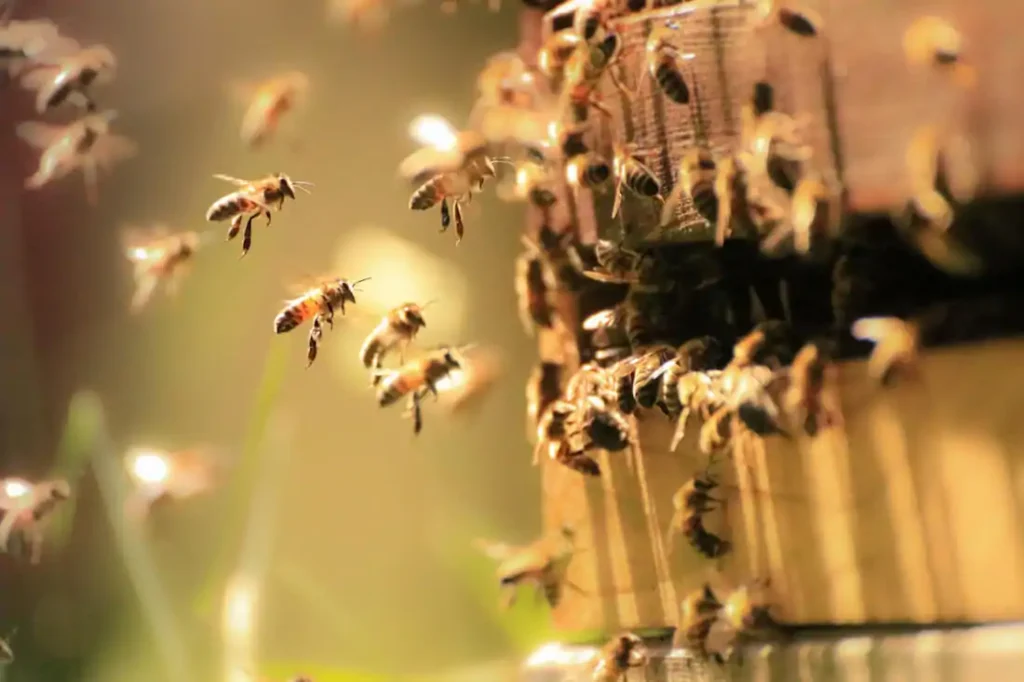
While we often marvel at the orderliness of ant colonies or bee hives and how the individuals take on specific roles and work together, this all pales when compared to the complexity and truly magical intricacy of human endeavour. All those people out there providing their services create the tapestry that allows us to buy what we need, drive our cars on beautiful roads, make phone calls, and everything else besides. One of my favourite clips is of Milton Friedman brilliantly explaining just how amazing it all is. The world really does run like a Swiss clock, and even though it sometimes feels broken, that brokenness itself is part of what’s needed for progress and fine tuning.
But in the same way that many people don’t see themselves as living lives of service, even though they are, so too I think most people don’t realise that much of the meaning in their lives actually comes from providing that service, even though it does. Our lives take on meaning when we serve others. A garbage man might not feel that his work has much meaning, but subconsciously he absolutely knows it does, and his happiness is the better for it.
Today, we’re hurtling headlong towards a future where ultimately everything mechanical and intellectual will be done better and faster by bots and computers than by humans. It seems unstoppable – our redundancy is certain and we have maybe a decade of practical usefulness remaining. This is no exaggeration. But when we stop working we stop serving, and when we stop serving we lose meaning. The impact this change will have on individuals and our societies is a complete mystery.
To add to the coming disruption, I don’t see how our economic models can survive what’s coming either. All economic theory is based on scarcity of supply, and up to now the overarching scarce resource has been human capital. What happens when this limiting factor is removed? What happens when the bots are mining the ore, running the steel mills, factories, ports, ships, and building everything, including more of themselves? With humans completely out of the loop, this has to result in exponential growth and the implications are hard to grasp. It may seem like science fiction, but it’s only a few years away.
Money is nothing but a useful medium that we in society agree to accept in exchange for the energy we expend. An actuary can charge more than a janitor because actuaries are more scarce than janitors. Throughout history, it’s humans that have, in this way, given money its meaning. But when human capital becomes redundant because bots can do everything better and faster, how do we do anything of commercial (monetary) value? I suspect that a few vocations, like the arts (and politics 🙄), may somehow remain viable, but how will the rest of us survive in a world where money has lost its meaning?
Tragically, we will likely greet our coming redundancy eagerly as a welcome end to wage slavery, especially once governments start handing out universal income, which I have little doubt they will have to do. In all likelihood, the shift to universal income will be sold to us as utopia and an age of abundance, but my fear is that before long it will settle into tyranny as those in power use the resources they control to ensure no dissent ever becomes a threat.
As a parent, my vocational advice hat has been stowed away for good. Short of counsel to pick a profession that has a more secure moat to keep AI out for longer, I really don’t have a clue. My son Sam became a dive instructor after dropping out of The Animation School, and now I think he’s probably better off for it.
This week, I’m back on the building site and will start putting up the rafters for the roof and hopefully the whole project will be completed before summer. Most people think it’s unusual for me to be building a home I’ve no financial interest in or intention of living in, but I’m happy to do it as a service for my family. By the time it’s done, I might have a better idea about how best to prepare for the coming AI disruption. Maybe my next project will be creating an off-grid microcosm of self-sufficiently on the farm. Being able to grow your own food certainly won’t hurt…
To see a world in a grain of sand
And a heaven in a wild flower,
Hold infinity in the palm of your hand
And eternity in an hour.
~ William Blake
Pray as though everything depended on God. Work as though everything depended on you.
St. Augustine
To be still
I live in that solitude which is painful in youth, but delicious in the years of maturity. ~ Albert Einstein
One thing I’ve loved about being on my own is the sheer abundance of quiet time. Entire days sometimes go by without interruption and where I don’t interact with another soul. I remember in my youth sometimes feeling achingly alone, but that’s a distant memory now. I’m not reclusive in the least; I still love spending time with friends and family, but getting back to the sanctity and solitude of my own space is almost always a joy.
Maybe it’s a novelty, but it’s been perfect for what I need now. Time to reflect and introspect. Time to marvel and lose myself in wonder or abstract thought. Time to pray and draw near to God. To examine and make peace with my longings. I think I, like many others, got so caught up in the busyness of day-to-day life that I seldom assigned myself dedicated me-time to just be, and now I delight in it. It feels to me almost like the homecoming of my prodigal self.
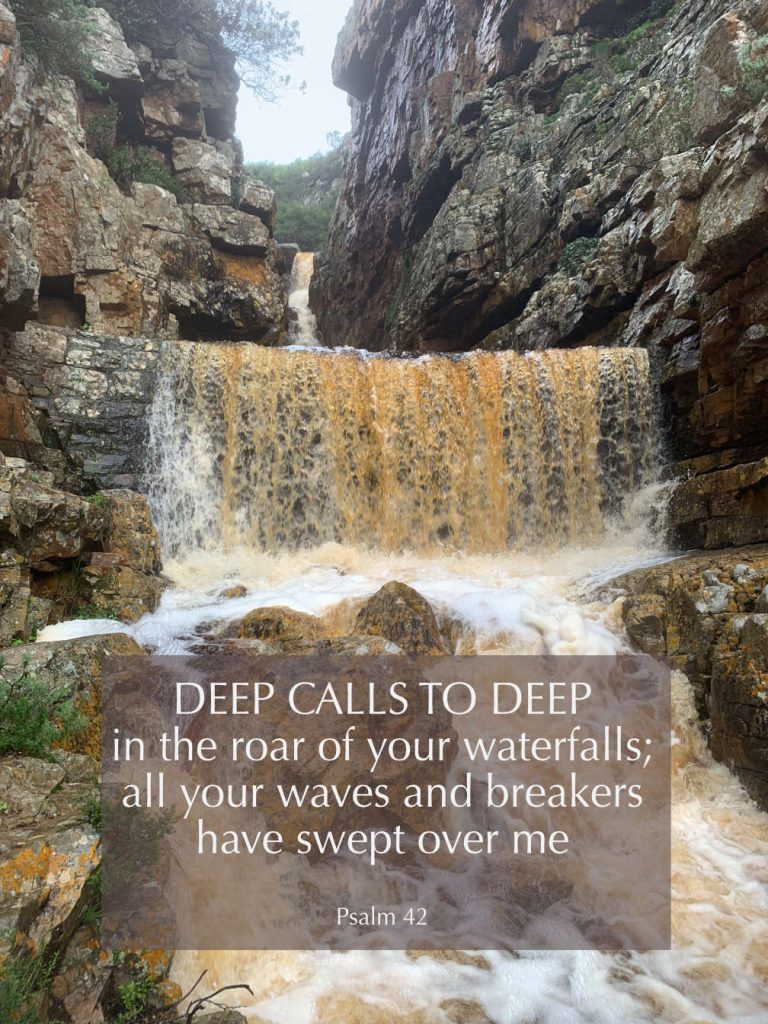
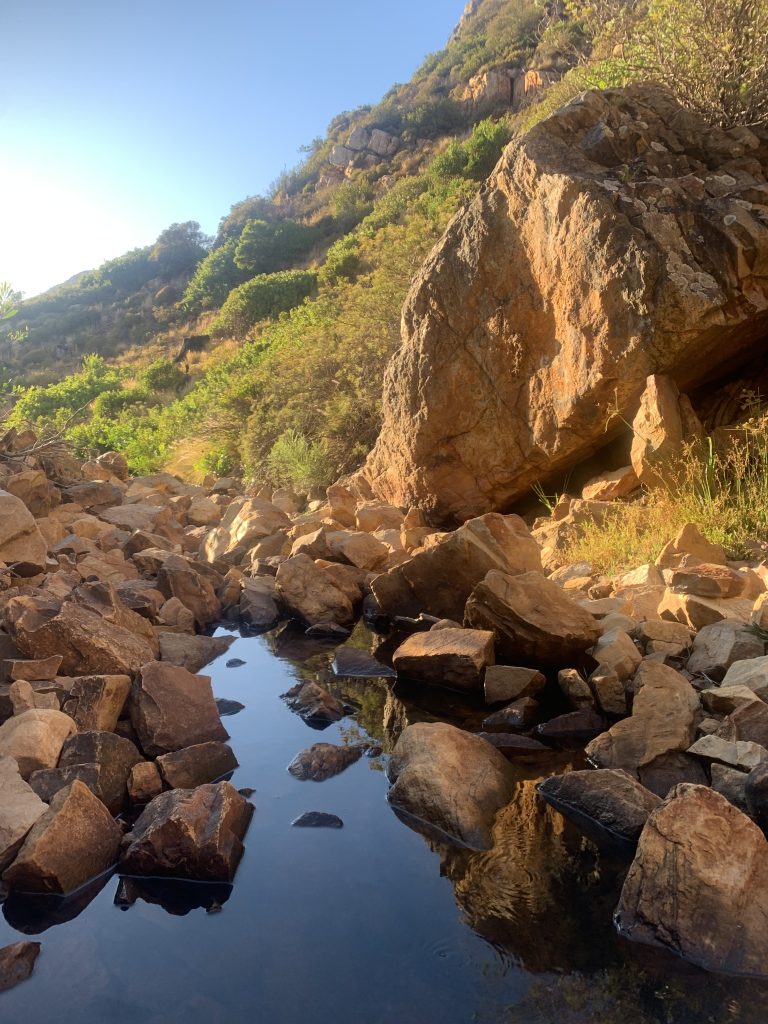
There’s a seasonal waterfall on the mountain behind where I live and I walk up there and then down to and along the beach most mornings to ground myself and remind myself of the beauty I’m immersed in. It’s a spiritual ritual I’ve made routine. Every day is unique – the sky, the birds, the sea, the sunlight on the mountain. The waterfall is a trickle now after the first rains of the coming winter and I’m eagerly looking forward to it being a thundering torrent again soon. Everything has a season, and indeed there will be time.
I’m sure my current state of being is also a phase, and in many ways I feel as though my life is at an inflection point between the old and the new, on my bodily journey from new to old. I have no idea what the future holds or what tomorrow might bring, but that’s exciting in itself and I’m filled with hope and optimism for what lies ahead. Like the opening of Robert Browning’s poem Rabbi Ben Ezra:
Grow old along with me!
The best is yet to be,
The last of life, for which the first was made:
Our times are in His hand
Who saith “A whole I planned,
Youth shows but half; trust God: see all, nor be afraid!”

O meu coração português
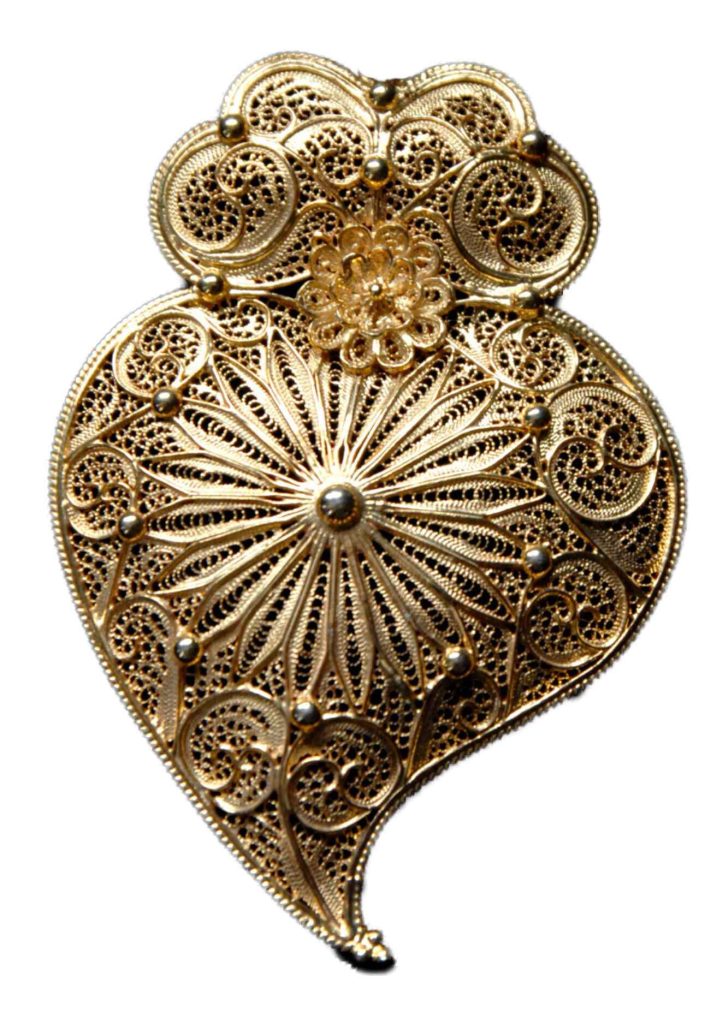
In January, I started a 150 hour online course to learn Portuguese to A2 level. It’s the final step in a citizenship program that we enrolled in as a family several years back, as part of an effort to mitigate some of the risks we face in South Africa and to broaden the options and horizons for Meg & Sam, now 21. I’d actually booked to sit the CIPLE exam in Maputo in November, but that got cancelled at the last minute due to the political instability in Mozambique.
This course involves four 4 hour classes from Monday to Thursday every week for about ten weeks. It’s a group class on a zoom-like platform, and to be honest, when I booked myself onto it, I saw it much as one would a chore or something to be endured. As it turned out though, I couldn’t have been more mistaken.
I see teaching is one of life’s wonderful asymmetries – so much more is gained by the students in a group class than what the teacher gives. When you have a gifted and passionate teacher, as our professora Joana is, the asymmetry is amplified further, and I’ve found myself looking forward to the classes every day and especially the last part of the class where we usually take a break from all the palavras, gramática e verbos, to delve into Portuguese culture and history, and what it means to be Portuguese.
In these parts of the class, we’ve meandered through so many topics, from Portuguese filigrana, futebol, fado, and Fatima, to some of the wonderful poems of Camões and Fernando Pessoa, the lost king Dom Sebastião, and the heroes of the sea who fearlessly set out to discover the world more than half a millennium ago. I never knew that saudade – a sense of nostalgia and longing – was so central to and deeply engrained in Portuguese ethos; this feeling that they have fallen and been humbled since the glory days, and still today dreaming of the misty day when Dom Sebastião will return. Of all I’ve learned about the Portuguese, I love this the most.
Isn’t it such a metaphor for many of our lives? For anyone who is even remotely self-analytical and introspective, the bravado and certainty of youth will gradually give way to a more measured and humbled view of ourselves and those around us as life schools us with its many lessons. The more crushing the experience or the deeper the cut, the more acute the lesson, and, if we let ourselves survive and not become embittered, we come out of it more humble and in touch with our humanity than before. Sometimes it seems to me that it’s only through heartbreak and devastation that the most precious seeds in our hearts can take root and flourish as our struggles and suffering define and refine us. We may end up looking back fondly on the heady days of youth when everything was so simple, but who would really want to return when our lives now are so much more grounded and rich than before?
Valeu a pena? Tudo vale a pena Was it worth it? Everything is worth it
Se a alma não é pequena. If the soul is not small.
But there’s a broader metaphor that I can’t help myself seeing, in that like the Portuguese, we humans are ourselves fallen beings. I don’t know about original sin and the serpent in the garden, but I do know that the knowledge of good and evil, however we got it, broke us as beings because it became impossible for any honest person to live up to the notion of perfect goodness that we were given at the same time. Even if we see ourselves as living perfectly good lives in our bubbles for example, Peter Singer’s seminal 1971 essay on famine, affluence and morality showed that everyone who has more than they need in a connected world is complicit to some degree when there are people starving. In a sense, I think this is why the Portuguese notion that it’s good to be poor, resonates so readily – the poor don’t carry the hidden burden of affluence in a broken world.
That this and other moral conundrums we face are impossible to solve is the whole point – we are not capable of our own salvation. Try as we may and should, we will always fall short, as true perfection and goodness are beyond us. In the end, anyone who believes that our lives amount to something more than molecular biology has little alternative but to also believe in the necessity of grace and redemption. That like the Portuguese dreaming that Dom Sebastião will return to redeem them, we too need a Great Redeemer and to know that despite our faults and fallen state, we are worthy of redemption.
So as the course draws to an end I’m left with a tinge of sadness and I know in time I will look back on it with a small sense of saudade. I came for the language but really learned how much I have in common with the people of Portugal. I’m not sure whether I’ll ever truly master Portuguese, but I do know that the words garagem and vizinha will remain forever tainted for me, and if there’s one noun I’ll never forget, it’s what the Portuguese call a ladybird – a Joaninha.

He leads me beside still waters. He restores my soul.
CO2 – Friend or Foe?
CO2 is the enemy, or so we’re told to believe. This narrative has become so pervasive that we’ve now reached a point where any alternative view or even questioning of the net-zero agenda is actually seen as being evil, with sceptics being branded as climate change deniers. Of course this is intended to put the sceptics in the same class as holocaust deniers, to wear their scepticism with shame, as a mark of Cain.
Let’s play devil’s advocate. Before deciding how to view CO2, let’s start with a problem statement. Here, every sane person agrees that what we’re really trying to prevent is a significant rise in global temperature, because if we don’t, we have to deal with downstream disasters like rising sea levels, leading to the flooding and loss of our coastal cities and island nations, the displacement of billions of people, and countless other horrors.
The current religion is that the only way to manage temperature is by reducing CO2, and any questioning of this is branded as heresy. But is there another way? As ever, I believe we’ve let the media and politicians capture our attention and polarise us, using fear and shame to trick us to believe that their anointed solution is the only way.
I’ve long thought that one of the problems of current climate change strategy is that it’s simply too short term. We’re putting all the focus on human related activities and forgetting that the world’s climate has been cycling through ice ages and tropical periods since the beginning of time. We’re currently coming out of an ice age and the sea levels have been rising slowly but consistently for the last 10,000 years – long before we humans could possibly have been to blame. All the civilisation we know has happened in this golden period and there is good reason for us to want to preserve it.
If we go further back in time to about 20,000 years ago, we were at the glacial maximum of the most recent ice age and the sea levels were 120 – 130m lower than they are today. Going still further back to the most recent interglacial period about 120,000 years ago, sea levels were about 9m higher than they are now. Such a rise today would absolutely ravage our coastlines and devastate countless cities including New York, London, Tokyo, and Shanghai. It’s too horrific to even contemplate. With or without CO2 and other effects of human activity, we have similar cycles ahead if we look far enough into the future.
The switch in thinking that I think we need to make is from the current “CO2 emissions are causing temperatures to rise so we need to cut emissions”, to “the climate is going to change with or without human activity and emissions, so what’s the best way to manage it”. This switch in thinking leads to the answer that if we want to restrict climate change and preserve current temperatures and sea levels, we really have no choice other than to find a way to actively manage climate.
Once we’ve agreed that climate management or climate engineering is a necessary part of our future, the next step is to decide how best to do this. Bear in mind that whatever solution we choose needs to be capable of both cooling and warming the earth when needed to counter the effects of human activity and natural cycles.
My Eureka moment came after I read an article in the New York Times a while back, which explored the idea of building a parasol in space to block out a fraction of the sun’s radiation. The article is behind a paywall, but you can read it for free by pasting the link into https://archive.is. This shield would only need to block out about 2% of the sun and would be completely invisible to the eye, because the remaining 98% of the sun would still be visible. Think of it like a giant sunspot – we wouldn’t be able to see it with the naked eye, just as we can’t see sunspots with the naked eye. It would need to orbit the sun in perfect sync with the earth, so that it always remained directly between the earth and the sun. There’s actually a point in space between the earth and sun called the Lagrange point where the gravitational forces of the earth and sun combine to make this orbit possible without propulsion – it’s about 1.5 million kilometres from earth, or about 4 times further than the moon. Interestingly, there’s another Lagrange point on the other side of the earth in the shadow of the sun, and that’s where the James Webb Space Telescope is!
The idea as a concept is actually not a new one and goes back at least a hundred years, but the idea of actually building what would need to be a gigantic structure in space would have been lunacy until recently. The NYT article goes on to discuss a prototype project, led by Yoram Rozen, a physics professor and director of the Asher Space Research Institute at Technion-Israel Institute of Technology, to build and position a small 100 square meter shield at the Lagrange point as a proof of concept.
But just how big would a real shield at the Lagrange point need to be to block out the required 2% of the sun’s radiation? Well, pretty big – about the size of Argentina! Ever the curious engineer, I set off to do some calculations…
One of the great things about space is that it’s inert – so one doesn’t need to deal with wind or weathering which would easily destroy a flimsy structure on earth. Another bonus is that there’s no gravity, so whatever structure is designed doesn’t need to support its own weight. If you took a huge sheet of super thin film, it would just float in space, folded or flat, exactly as you left it. We can easily fabricate aluminium foil down to 1 micron thickness, and foil that thickness would weigh 2.7 tons per square kilometre. Argentina is about 2.8 million square kilometres, so if we could use 1 micron aluminium foil, the total weight of a sheet the size of Argentina would be about 7.5 million tons. Of course we couldn’t have a single sheet that size and whatever we built would need to be modular, on some kind of structure. If we double the foil weight as an estimate to cater for the weight of the structural components, we get to a rough total mass estimate of 15 million tons.
Is it even possible to move this kind of mass to space? Until recently not, but Starship can carry about 100 tons per launch, so that would mean about 150,000 launches, or about 20 per day for 20 years. But wouldn’t the cost make it impossible? The cost of the material for the shield itself would be insignificant, and of course it would be assembled robotically in space. The real cost would be getting it to space. SpaceX’s goal is to get Starship payload cost to orbit down to $10 per kg, which would be $150 billion for 15 million tons. Of course it’s going to be more expensive because the Lagrange point is a lot further than low earth orbit, but even if it’s 10x more expensive, it’s still $1.5 trillion. By comparison, I read an article recently that claimed that the estimated global cost of moving towards net-zero is currently about $2 trillion annually.
The beauty of engineering climate using a sun-shield is that it’s completely non-destructive from a planetary perspective, and it’s reversible and extendable. Need more heat? Turn the shield sideways to block less sunlight. Need more cooling? Turn the shield perpendicular to block more sunlight or even extend it to make it larger.
If we were to have a shield like this, how would we view CO2 – would it still be public enemy #1 as it is today? Absolutely not. We can cool the earth as much as we want with a shield, but there’s a limit to the amount of heating we can do because we can’t let through more than 100% of the sunlight. The real climate danger would be another ice age, which will inevitably happen as part of natural climate cycles. The wonderful thing about CO2, apart from the fact that plants and trees love it, is that it would be helping to warm the planet and fend off an ice age when we need it most!
Although I’m sure there may need to be some adjustments to my rough calculations, I have little doubt that it would be possible to design and construct a solar shield to help us manage earth’s climate in the long term, and that the cost and societal impact would be a tiny fraction of that of todays net-zero agenda. But if this is true, then why is this solution not getting more attention and why are we so fixated on net-zero as the only way to mitigate climate change? As ever, I believe that the politician’s old tools of fear and shame to divide and rule, are the culprits.
Voice or no voice, the people can always be brought to the bidding of the leaders. That is easy. All you have to do is tell them they are being attacked, and denounce the peacemakers for lack of patriotism and exposing the country to danger. It works the same in any country. ~ Hermann Goering
Through the ages, it doesn’t really matter whether the enemy is the enemy is Zionists (Jews), a virus, or CO2. As long as an enemy can be identified, a narrative can be established and those who question or challenge the narrative can be attacked and shamed. Climate sceptics become climate deniers, just as lockdown sceptics became granny killers and vaccine hesitant become anti-vaxxers. In this way, society is carved up, polarised, and every significant issue becomes political.
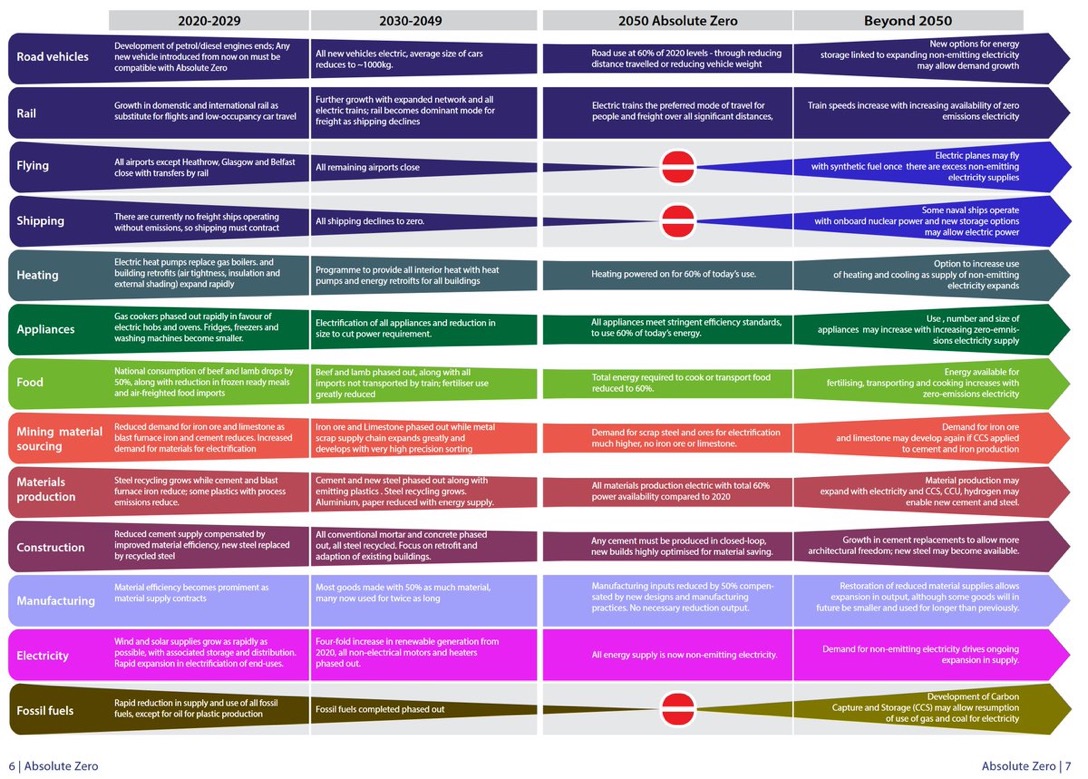
For the most part, I think most people concerned about climate change are simply unaware that there might be other or better alternatives to net-zero. The vilification and shaming of sceptics or anyone who dares question the CO2 climate religion is sufficient to discourage the few who would otherwise be open minded or do their own research. This was certainly the case for me. But apart from ignorance, I’m increasingly concerned that there are forces behind the net-zero movement that are more motivated by power and control than by any of the risks of climate change itself. Forces driven by what seems to be a fundamentally elitist and anti-human set of values. One set of rules of thee and another for me, where all people are equal but some are more equal than others. While many people may not be aware about the specifics of what exactly net-zero entails, a recent report by government funded UK FIRES published a helpful and revealing infographic roadmap to net-zero 2050. Although it shows, for example, that there will be no flights or shipping by 2050, you can be sure that’s only for the proles, and the Davos class will be unaffected.
For me, one of the tragic outcomes of the net-zero movement has been the capture and corruption of environmentalism and other ethical activist causes. Old school vegetarians made their choices because they didn’t want to be associated with animal suffering. Bizarrely, today many shun animal products to reduce their carbon footprint instead. In the past, environmentalists and activist organisations like Greenpeace would have been horrified at the thought of huge wind farms decimating landscapes and putting threatened birds or whales at risk. Today all is overlooked and any sacrifice is acceptable as long as it’s to appease the climate gods. I don’t know about you, but I’ll take old school environmentalism and activism any day and I’d far rather invest my energy in preserving nature and habitats for their own sake than to fit some cooked-up second order effect where even the science is in dispute.
For my own part, I’ve moved away from being fixated on my carbon footprint and the amount of fossil fuel I burn – as far as I’m concerned, if we can extract oil or gas with little impact or risk to natural habitats and ecosystems, that’s fine by me. At the same time, I’m as pro-renewables as ever, just not at any cost. I’ve found this change in attitude has assuaged the guilt I once felt and helped make me a happier person – now my main concern when filling up my car is the price on the pump!
Patience is the companion of wisdom.

St. Augustine
Going solo
So here I am alone in the wilderness of the Karoo, and the song in my mind is by Cat Stevens and goes “Miles from nowhere, guess I’ll take my time, oh yeah, to reach there. Look up at the mountain I have to climb, oh yeah, to reach there”.
Strange thing this affliction that some of us have, almost an aversion to excessive comfort or compromise. Maybe driven by a longing for something undefined. God. Love. Beauty. I know I’m not the first…
I stumbled across the story of the Cathars a while back – they were a Christian sect centred around southern France in the late Middle Ages. They called themselves the Good Christians and believed that we human souls were actually angels that had been separated from God, trapped on earth in physical form and destined to suffer until the separation was finally over. They refused to kill or consume meat, regarded men and women as spiritual equals, and shunned procreation because they believed that only when humans were no more, would the the trap be broken and the angels be liberated. Central to their belief was that suffering is inseparable from being human, and that our suffering is an inevitable result of our separation from God and our longing to return to Him.
It’s a common theme. In Plato’s Symposium, Aristophanes recounts the delightful myth of the androgynous people that preceded modern humans, when we had four legs, four arms, two heads, and there were three genders: male-male, male-female, and female-female. They were immensely more powerful beings than we are today and when they challenged the gods and lost, Zeus decided to cleave them all as punishment and to ensure it would never happen again. According to the myth, we are all half-beings and our destiny is to feel incomplete and spend our lives searching and longing for our missing half. In the same book, Socrates talks about the journey from longing for beautiful things to beautiful bodies to beautiful thoughts and finally to the contemplation of the essence of beauty itself.
We may ridicule the Cathars or the Greeks, but I think their myths and beliefs were just manifestations of the same underlying human condition that we, while blessed, are somehow broken and incomplete beings. I think this human feeling lies at the heart of so many beautiful poems and works of art, even great works of science. As Einstein himself said, feeling and longing are the motive forces behind all human endeavour and human creations.
Had the Cathars been a small sect, they would in all likelihood have been left alone, but they were not. They were branded as heretics by the Catholic Church, who naturally saw them as a threat, and they were subjected to a series of inquisitions aimed at their persecution and eradication. In 1209, Pope Innocent III finally instituted the Albigensian Crusade against them, although the crusade was not just against the Cathars; the Catholics of southern France had lived happily alongside their Cathar neighbours and supported them in their defence against the crusaders. But their fate had been sealed and when the remaining Cathars, along with thousands of their Catholic defenders from the surrounding region took refuge in the city of Beziers, it was besieged. The siege was broken later that year and Arnaud-Armoury, the crusader abbot-commander gave the order to kill the Cathars as the city was sacked. When reminded that there were many more Catholics than Cathars in the city and asked how to tell them apart, he replied with the immortal line “Caedite eos. Novit enim Dominus qui sunt eius“—”Kill them all, the Lord will know His own”. The Cathars finally got their wish, just by genocide and not by the means of their own choosing.
I read somewhere once an idea that rang true along the lines that there is no dogma, however absurd, that some people won’t be prepared to die for, or others prepared to kill for. I’ve had an aversion to all forms of dogma for as long as I can remember. A natural sceptic, I need to seek knowledge and distill my own truth rather than have it prescribed to me. In some ways I guess that where I now find myself in my life journey reflects this – never willing to accept all the elements of the hand I’ve been dealt, and continually questioning whether my direction is true.
So here I am, at 62, on my own path again. At least I didn’t wait until real old age, like Tolstoy. He left home at 82.
Miles from nowhere,
Not a soul in sight,
Oh yeah, but it’s alright.
I have my freedom,
I can make my own rules,
Oh yeah, the ones that I choose.


